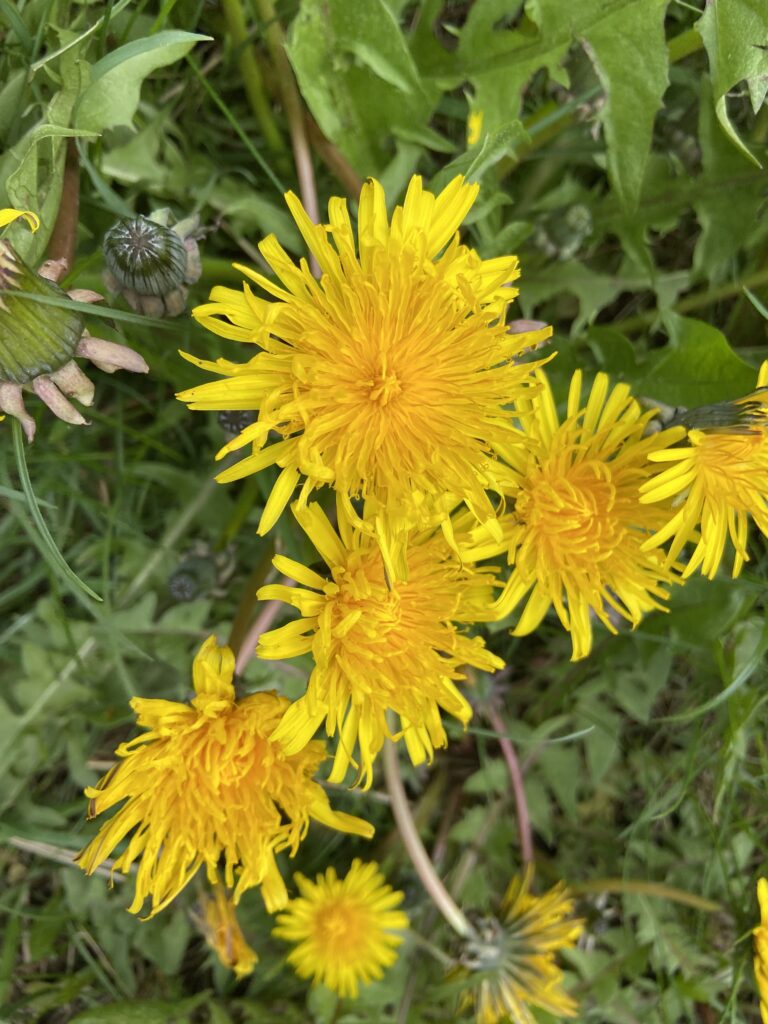
I love the dandelion. Its cheery burst of yellow mirrors the sun as it builds back into full strength. In seed, it reflects the beauty of the moon.
Dismissed as a weed for decades, people are beginning to recognise its immense value.
Apart from lifting our spirits after a long winter, it has food and medicinal value, as well as playing a vital role in our ecosystem.
Food wise, the fresh leaves (to be picked when newly grown) are a great addition to salads and good in sandwiches, sprinkled with a little salt, lemon juice and pepper. Remember to wash them carefully, especially if they’ve been picked from area where people walk their dogs… Dried dandelion leaves have been used for centuries in herb beers, Dandelion stout being a particular favourite in the Potteries of the Midlands when the furnaces roared at their height. Dandelions, nettle and dock, also make a good, fermented drink. Dandelion wine is an old country favourite. (A rather lethal preparation was made by a friend to be consumed at our wedding. It created a bundle of very tipsy guests!)
Dandelion flowers add extra colour and vibrancy to salads and are a rich source of source of vitamins (A, C, E, K, and B) and minerals (calcium, sodium, magnesium, iron, copper, silicon, zinc, manganese), as are the leaves and root.
The roots (when dug up in October) after cleaning and drying, can be roasted slightly. Once ground into powder, it makes a good coffee substitute. I’ve tried it and its very palatable.
The consumption of the leaves and root are medicinally useful as they stimulate the whole system, helping the liver and kidneys do their job and keeping the bowels healthy. More recent studies are recognising that its antioxidant and anti-inflammatory properties have had a beneficial effect on the cardiovascular system in lab conditions. https://pmc.ncbi.nlm.nih.gov/articles/PMC9002813/
The early flowering makes dandelions an important food source for pollinators such as bees. Many different caterpillars enjoy the leaves, later turning into various different butterflies and moths. Bull finches, greenfinches, goldfinches and serins feed from the seed heads.
Interestingly, I’ve heard that when modern horticulturalists tried to propagate dandelions by seed, they were notoriously difficult to germinate. Yet when they are blown in the wind or by children asking the dandelion clock for the time, they appear in abundance. To me this signifies that the dandelion is a free spirit. What do you feel about this amazing plant?
For further details on cultivating, harvesting and preparing the dandelion, plus medicinal recipes, check out Mrs Greave: A Modern Herbal. (This book is a definitive collection of the old plant knowledge collected in the 1920s with amazing foresight- most m
« Back to blog page